 Log in

Google is making it easier to restrict its A.I. tools for students. But schools that block A.I. entirely will lose student access to Google’s search engine.


We just got a huge win for one of the most important conservation areas in the South – the rural ACE Basin.
On behalf of local residents, SELC sued and just reached a settlement that prohibits data centers across a majority of the ACE Basin in Colleton County, South Carolina, including a massive 850-acre, $6 billion data center proposal.
This newly protected area is home to some of the most ecologically sensitive areas along the three major rivers that form the basin: the Ashepoo, the Combahee, and the Edisto.
This 1.6-million-acre watershed is steeped in rich history and diverse Lowcountry culture that also serves as prime habitat for waterfowl, migratory birds, and endangered species.
The agreement establishes a “Data Center Exclusion Area” covering a majority of the ACE Basin in Colleton County. Most significantly, it includes the 850-acre parcel on the headwaters of the Ashepoo River where the original Eagle Rock data center complex was proposed in December 2025.
Since the proposal was announced, Colleton County residents, environmental groups, and people from across South Carolina have made one thing clear: this is the wrong place for a data center.
We’re thrilled that this area will be protected from data center development but remain committed to continuing to work with county leaders, residents, and stakeholders to help ensure that any data center projects in Colleton County and beyond are developed responsibly and with the transparency and accountability communities deserve.
This victory shows us what we can accomplish when we work together with communities across the South.
Data centers are rapidly expanding across our region, and SELC is working alongside communities to ensure this growth doesn’t come at the expense of clean air, clean water, wildlife, and the people who call the South home.
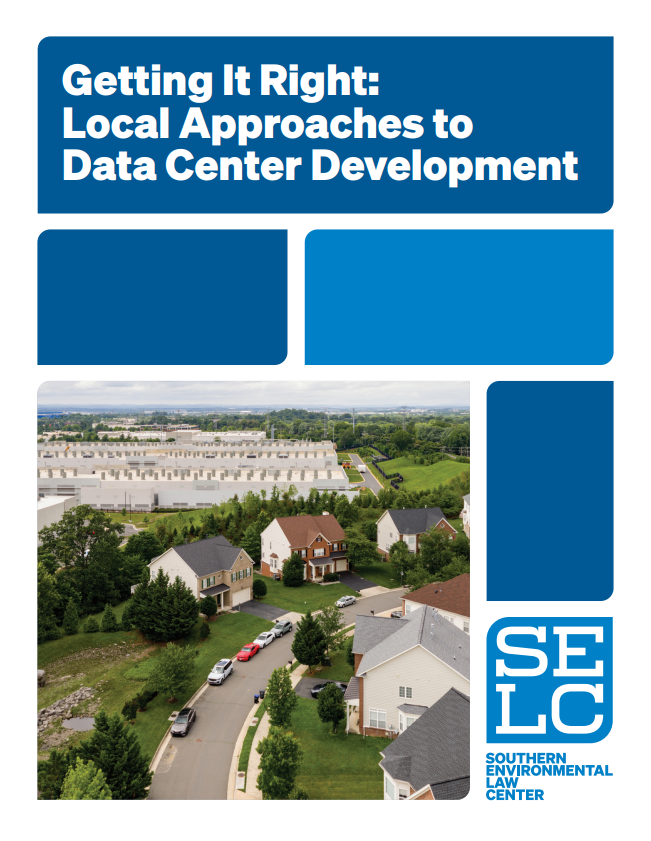
report
Getting It Right: Local Approaches to Data Center Development
A new resource from the Southern Environmental Law Center demystifies one of the best—and sometimes only—tools to ensure responsible data center development: local zoning authority.
Data centers are an increasingly prominent part of our modern society and can power valuable services. But they are also extremely resource-intensive and can consume vast amounts of energy, water, and land. Their explosive growth in the Southeast and elsewhere is putting tremendous pressure on energy systems, electricity rates, water supplies, and natural and historic resources, while often generating significant air and noise pollution.
Local zoning authority often provides communities with their best opportunity to exert any meaningful influence over data center development. This report offers various considerations for using zoning ordinances and local advocacy to address the unique challenges data centers present and to promote transparent and accountable decision-making about these facilities.
Section One explores some of the community and environmental impacts that data centers can cause. Section Two discusses various options for how local zoning ordinances can effectively empower local governing bodies to address data center development in an informed, responsible, and transparent way. Section Three discusses real-world examples of data center-specific development requirements that could be included in zoning ordinances. Finally, Section Four offers suggestions on how communities can engage most effectively on individual data center proposals.
Combining thoughtful zoning ordinances with smart public involvement is one of the best strategies currently available for shaping responsible data center development, and it is one that all localities confronting this growing challenge should be pursuing.



A massive trove of driver’s license scans allegedly stolen from an identity verification company shows the danger of creating honey pots of our most sensitive documents for malicious actors to exploit.

Teachers need to model the passion they want to see.

There are no lossless transformations of natural-language text
Sophie Alpert shares her "internal policy on acceptable use of AI writing by engineers". It's a short read (supporting its own recommendations) and really good.If you chose to have LLMs help massage your writing the following rule seems crucial to me:
You must stand behind every idea and every sentence in your docs. It is your responsibility to make sure that the entire document is representative of your own thoughts before you share it. If a reviewer asks, “What did you mean by this line?”, it’s not acceptable to reply with “Oh sorry, AI wrote that, just ignore it.” You will confuse your readers (and waste their time) if you present them things that are not genuinely representative of your thoughts.
The "no lossless transformations" idea from the post title is expanded on here:
There are no lossless transformations of natural-language text — every rewrite and rephrase changes the meaning of your writing, and if this is done by an entity that doesn’t have the most detailed mental representation of what you personally were trying to communicate, information will be lost.
Tags: writing, ai, generative-ai, llms, ai-misuse

Public Education Is Democracy’s Strongest Investment
By: Dr. Kenita T. Williams, Vice President and Chief Operating Officer, Southern Education Foundation
Editor’s Note: This article is the first in a series exploring key findings from the Southern Education Foundation’s Economic Vitality and Education in the South, Part II: Projections for a Post-Pandemic South (EVES II) report. Throughout this series, we’ll examine the many interconnected factors shaping the South’s future and what they mean for students across the learning continuum, communities, and our region.
Across the South, public education has always represented something larger than a school building. It represents possibility. It is where young people discover who they are, where communities come together, and where we make one of our most important collective commitments that every child deserves the opportunity to learn, contribute, and thrive.
Today, that commitment is more important than ever.
The Southern Education Foundation’s latest report, Economic Vitality and Education in the South, Part II: Projections for a Post-Pandemic South (EVES II), makes one thing clear: the future of our region depends on the educational opportunities we provide today. As the South continues to grow and educate more than two out of every five public school students in the United States, the choices we make now will shape not only our workforce, but our democracy.
Democracy depends on more than elections. It depends on opportunity. It depends on ensuring that every student has access to a high-quality education that prepares them to participate fully in their communities, pursue meaningful careers, and contribute to our shared future.
EVES II highlights a growing challenge. In the coming years, our nation will need more healthcare professionals, engineers, technology experts, educators, and skilled workers than ever before. Yet too many students continue to face barriers that limit their access to the educational pathways leading to those careers.
These barriers are not simply educational, they are economic and societal. A student’s opportunity to succeed is influenced by factors such as access to early learning, stable housing, healthcare, school resources, and community support. The report’s Social Determinants of Education framework reminds us that when we strengthen these conditions, we strengthen educational outcomes and, ultimately, our workforce and economy.
Perhaps the report’s most important message is one that deserves greater attention: expanding educational opportunity benefits everyone.
Too often, conversations about educational opportunity are framed as if helping some students means taking something away from others. The evidence tells a different story. When more students have access to a quality education, we expand the pool of future nurses, teachers, entrepreneurs, scientists, and civic leaders. Greater opportunity creates stronger communities, a more competitive economy, and a healthier democracy.
Public education remains one of the few institutions designed to serve every child while protecting students’ rights, well-being, and opportunity. That mission deserves our continued investment and support not only because it benefits individual students but also because it benefits all of us.
The future of the South will be shaped by the investments we make today. If we want thriving communities, a prepared workforce, and a strong democracy, we must continue to strengthen education and ensure every student has the opportunity to succeed.
Public education is more than a public good. It is one of democracy’s greatest investments in our shared future.
The post Public Education Is Democracy’s Strongest Investment appeared first on Southern Education Foundation.
Next Page of Stories